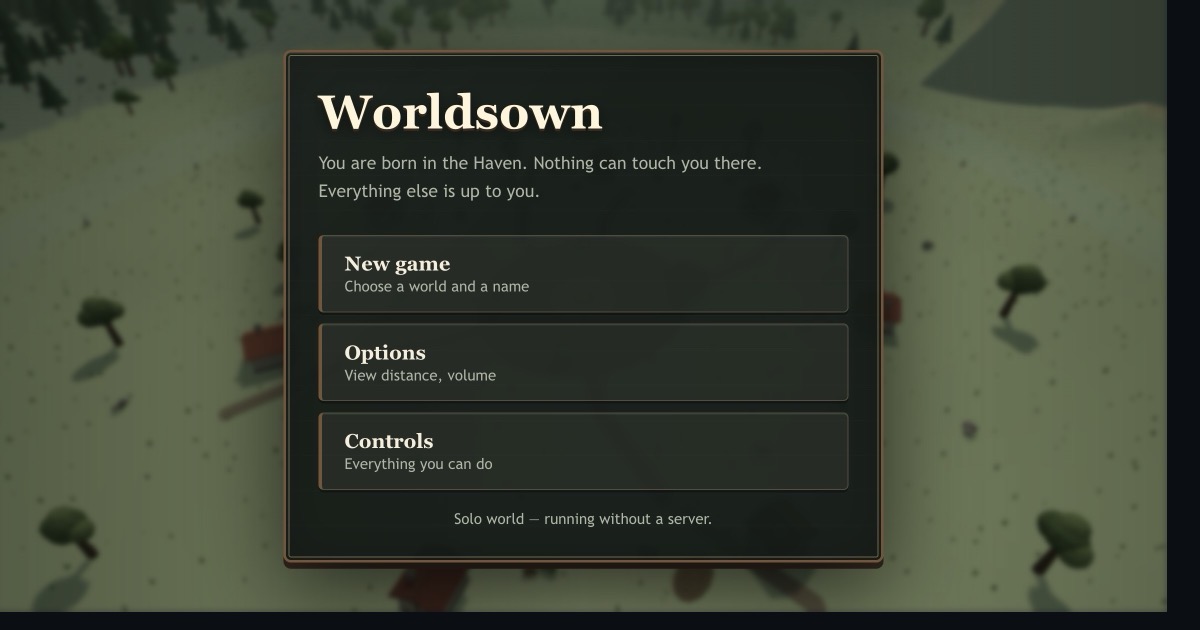
A world that begins with safety
Worldsown is a free browser survival game about leaving a place where nothing can hurt you. Every character begins in the Haven, a sanctuary built around a fire, a workbench, a trader, and the people who teach the first lessons. Food, warmth, equipment, and danger only become urgent when the player chooses to walk beyond its stones.
That choice is the game’s central idea. Survival should not begin as a list of punishments before a new player understands the controls. The Haven gives players time to look around, meet other people, and decide when they are ready. The wilderness then makes that decision meaningful through changing terrain, weather, darkness, wildlife, and limited supplies.
Why Worldsown exists
The project began with a question: can a multiplayer world feel persistent and shared without requiring a large download, an account-creation wall, or an always-running fleet of expensive servers? Worldsown is the answer being built in public. A modern browser is the client, procedural systems provide the landscape and its inhabitants, and serverless infrastructure wakes when players need to exchange shared state.
The goal is not to make survival complicated for its own sake. Each system should create a decision players can understand. A campfire is warmth, light, and cooked food. A boat turns a coastline from a wall into a route. A chest is valuable because another player can find what was left inside. Armor matters because the creatures beyond the Haven become progressively less forgiving.
How the world is built
The wilderness is generated from a seed. Terrain, biomes, vegetation, villages, harvestable resources, and wildlife are produced from deterministic rules, so players using the same seed enter the same geography. The client streams the nearby world in chunks instead of loading an enormous map at once. This keeps the game quick to open while allowing exploration to continue far beyond the starting area.
Animals are assembled from low-poly geometry and share a small behavior system. They graze, wander, flee, hunt, seek cover, and rest according to their species. A rabbit and a bear are not merely different models: they notice the player at different distances, move differently, survive different amounts of damage, and offer different risks and materials.
The visual direction follows the same practical rule. Models, item artwork, sound effects, and much of the music are procedural or built directly into the client. This gives the world a consistent handmade character and keeps the experience lightweight enough to play from a link.
A shared world, not a paused one
Worldsown supports solo play, but its systems are designed around the possibility that somebody else is nearby. The game world does not pause when a menu opens. Players can chat, travel together, share a boat, leave resources in public chests, and meet in a world whose terrain agrees across every connected client.
The backend stores the pieces that need to survive a browser refresh or be agreed between players: identity, inventory, equipment, currency, and shared objects. Features are introduced only when their behavior can be clear in both solo and multiplayer play.
Development principles
- Readable rules. Players should be able to predict what an object does from its appearance and previous experience.
- Useful rewards. Quests teach real systems and award equipment that changes what the player can safely attempt next.
- One source of truth. These guides read the same creature, recipe, item, and quest data used by the game.
- Accessible delivery. The world should open in a browser and remain playable without a large installation.
- Measured growth. New systems should deepen the shared world instead of adding disconnected checklists.
Where it is going
Worldsown is an evolving game. The current world already supports exploration, survival needs, crafting, cooking, trading, quests, equipment, boats, beds, campfires, storage, wildlife, hostile creatures, and shared multiplayer state. Future work will continue to strengthen the relationships between those systems and add reasons for players to return to familiar places with new goals.
The best way to understand the project is to enter the Haven and take the first path outward. Feedback from those journeys directly informs what is clarified, balanced, and built next.